Two of our students on the district badminton podium
At the badminton competition run by the District School Sports Association, Sahadeb Barman of Class XI finished first and Rajdeep Das of Class XII finished second. Congratulations to both.
ঘোকসাডাঙ্গা প্রামাণিক উচ্চ বিদ্যালয় (উঃ মাঃ)
“শ্রদ্ধাবান্ লভতে জ্ঞানম্”
The one who has reverence attains knowledge.
At the badminton competition run by the District School Sports Association, Sahadeb Barman of Class XI finished first and Rajdeep Das of Class XII finished second. Congratulations to both.
Pupils decorated their own classrooms, welcomed the staff, and then stood at the front and taught. The afternoon closed with dance and music in Vidyasagar Bhavan, and handmade gifts for every teacher.
Students wrote on the teacher who mattered most to them. The Head Teacher presented the prizes to the winners during the Teachers’ Day programme.
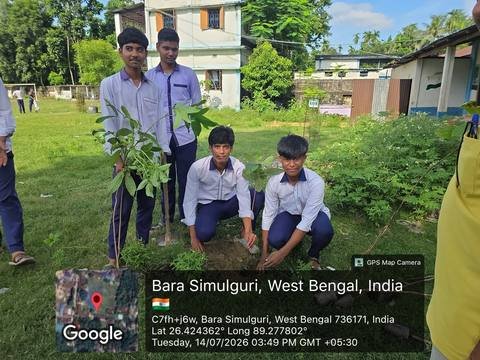
Senior students planted and staked young trees along the edge of the playing field — shade for the pupils who come after them.
Ghoksadanga Pramanik High School (H.S.) opened its doors on 10 March 1953, in a corner of Mathabhanga where, at the time, a secondary education meant a long journey away from home. It was founded by Sri Pramanik Barman, a man from a peasant family who believed the children of his village deserved a school of their own.
More than seven decades later, that school teaches Classes V to XII to boys and girls together, preparing them for the Madhyamik examination of the West Bengal Board of Secondary Education and the Higher Secondary examination of the West Bengal Council of Higher Secondary Education.
The school describes its own purpose plainly: to make learning the main priority, to nurture the all-round development of its students through creative activity, and to keep a positive relationship and mutual respect between students and staff. For a great many families here, it remains the place where the first person in the household learns to read an examination paper.
He was not a wealthy patron. He came from a peasant family in this same countryside, and he understood exactly what it cost a farming household to send a child to a school in a distant town — and what it cost them not to.
So in 1953 he gave his village a school instead. The institution carries his name to this day, and generations of students from Ghoksadanga, Baro Simulguri and the villages around have passed through it on their way to Madhyamik, to Higher Secondary, and to lives their grandparents could not have planned for.
His memorial stands on the campus he created. Every student who walks past it walks past the reason the school exists.
“Education is a life-long process and not mere preparation for life.”
When this school was founded in 1953, the ambition was simple and enormous at once: that a child from a farming family in Ghoksadanga should not have to leave the village to become educated. That ambition has been met many thousands of times over. The question now is what the next seventy years should look like.
The world our students will enter is not the one their parents entered. A young person leaving Class XII today will be asked to use a computer, to read and write confidently in more than one language, and to compete for college seats and jobs with students from cities far larger than ours. Our responsibility is to make sure that a rural address is never the reason a capable child falls behind.
That is where we are directing our effort: strengthening our science laboratories and smart classrooms so that practical learning is genuinely practical; making our computer and ICT facilities something every student uses rather than a few; keeping our girls in school through Class XII, right up to the board examination; and giving first-generation learners the extra academic support that turns enrolment into achievement.
We ask parents and well-wishers to remain close to the school. Come to the meetings, ask about your child’s progress, and tell us where we can do better. An institution founded by a farmer for his neighbours’ children belongs, quite properly, to the community it serves.
The school teaches an eight-year path, from the first year of upper primary right through to the Higher Secondary examination.
Our district has given India reformers, modernisers and public figures known far beyond Bengal. We place them before our students as proof of what this soil produces.
Born at Khalisamari in Mathabhanga — the same subdivision as this school. He took his MA and LLB from the University of Calcutta and devoted his life to the education and dignity of the Rajbanshi community. Cooch Behar Panchanan Barma University carries his name.
He rebuilt the state around its institutions — schools, colleges, hospitals and roads. Victoria College taught to the MA standard of the University of Calcutta, and in 1884 he abolished the last remnants of slavery in his state.
Born a princess of the Cooch Behar royal house and later Maharani of Jaipur, she was elected to the Lok Sabha from Jaipur in 1962 and served three terms. A founder of schools herself, and among the most internationally recognised Indian women of her century.
As recorded in the school’s official listing with the Government of West Bengal.
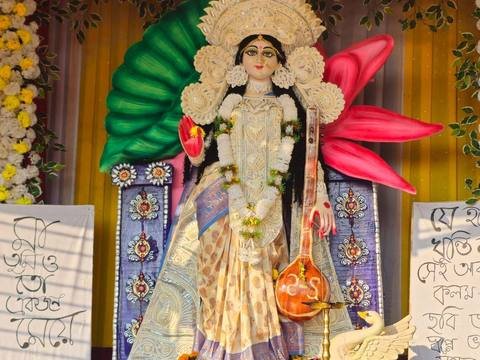
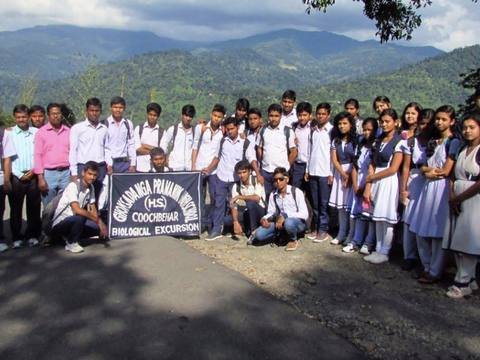
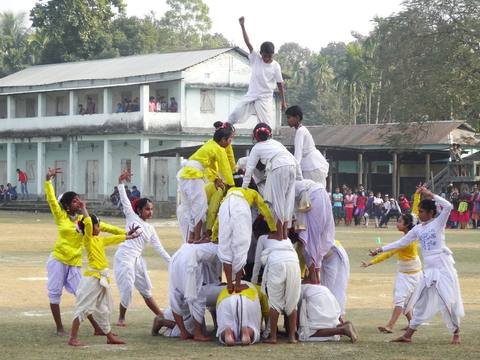
Assembly on the field, Saraswati Puja, the excursion to the hills, sports day, and an ordinary morning in class.
The school stands at Ghoksadanga, in the Mathabhanga – IV block of Cooch Behar district.
Open in Google Maps
He spent his working life at this blackboard, and the lesson did not end when he left it. Every student he taught carries a little of him forward. শিক্ষক কখনও বিদায় নেন না — তাঁর পাঠ প্রতিটি ছাত্রছাত্রীর মধ্যে বেঁচে থাকে।